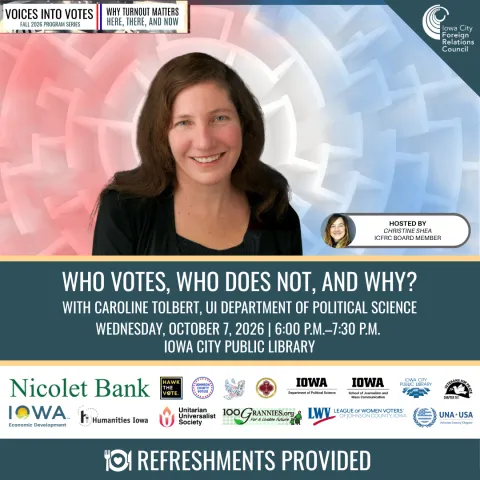
In this Iowa City Public Library event, political scientist and UI faculty member Caroline Tolbert will examine one of the central questions facing modern democracies: Who votes, who does not, and why?
Drawing on research from the United States and other democracies, she will explore how electoral rules, voting laws, demographic factors, and political trust, partisanship, and other factors shape participation and representation.
How does the United States' two-party system influence whether voters feel they have meaningful choices at the ballot box? How do closed primary elections affect the nearly 30 million Americans who identify as independents in states that restrict their participation? Which election laws strengthen voter participation, election administration, and confidence in election outcomes—and which may create barriers to voting?
Tolbert’s talk will examine major election policies and proposed reforms, including no-excuse absentee voting, early in-person voting, automatic voter registration (AVR), online registration, same-day registration (SDR), voter identification requirements, documentary proof of citizenship, redistricting, campaign finance, and reforms to primary elections. Attendees will also learn how public trust in elections influences participation and confidence in democratic institutions.
The presentation provides an evidence-based overview of why voter participation varies across groups and countries, how election rules shape participation, and the tradeoffs policymakers face in balancing election integrity and ballot access. Participants will leave with a deeper understanding of the policies that influence who participates in elections and how those choices affect our democracy.
Presented in partnership with the Iowa City Public Library, Hawk the Vote, and The University of Iowa Department of Political Science.
This event is free and open to the public. Refreshments will be served.